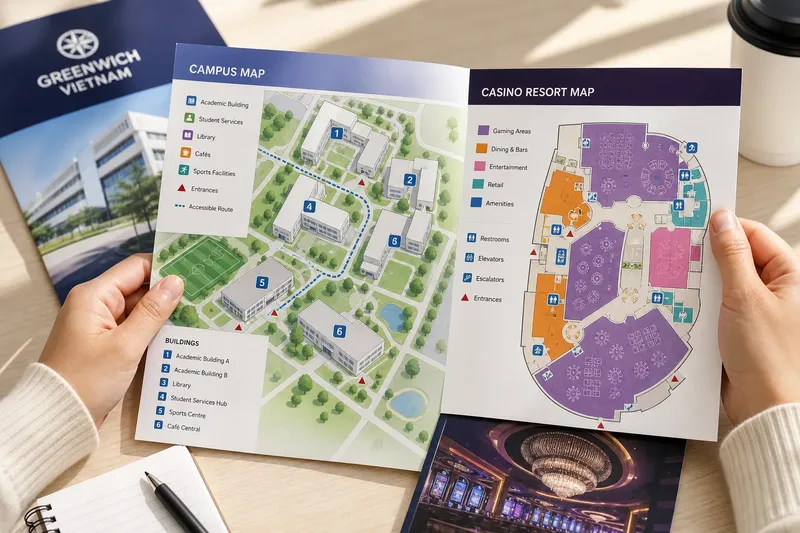
How Casino Design Helps Explain Greenwich Vietnam’s Campus Geography
Compare Greenwich Vietnam campus geography with casino destination design to distinguish how academic routines and visitor leisure shape the use of shared space.

The common mistake in comparing Greenwich Vietnam campus geography with casino destination design is to focus on entrances and facades. That costs the reader a clearer account of what each place connects: student routines and academic support on campus, or leisure activities and hospitality at a casino destination.
Different Spatial Purposes
Greenwich Vietnam is a university setting, so its geography is best considered through the relationship between learning, student services, and daily routines. A casino destination is organized around leisure and may bring gaming together with dining, lodging, or performances.
These places can be compared without treating them as equivalents. The useful question is how each arrangement supports its intended activities, not which one looks more impressive or welcoming.
Campus Connections
Campus geography concerns the links among teaching spaces, places to meet, and student support. Those connections shape how a student moves between scheduled study and the less formal parts of university life.
When writing about Greenwich Vietnam, distinguish general campus principles from claims about a particular location. If you cannot verify that a specific building, service, or shared area exists at a given site, describe the question to investigate rather than presenting the feature as fact.
Casino Circuits
Casino destinations often combine several leisure and hospitality functions. Their spatial logic can be discussed in terms of how visitors move among gaming, dining, entertainment, and accommodation, where those functions are part of the destination.
This creates a different kind of movement from student life. A visitor may choose among activities during an outing; a student’s routine is tied to learning and recurring campus responsibilities. The distinction is about purpose, not a claim that every visitor or student behaves the same way.
Comparison Checklist
Use these checks to keep a place comparison specific and fair. Each decision depends on what the description actually establishes.
- Check whether the campus description names a learning activity; if it does, explain how nearby spaces could support that activity, but if it does not, ask for a verified example before making a layout claim.
- Check whether a claim identifies a Greenwich Vietnam site or building; if it does and you can verify it, discuss that feature, but if you cannot, keep the statement at the level of general campus geography.
- Check whether the casino description includes activities beyond gaming; if it does, explain how they relate to leisure, but if it does not, avoid implying that dining or performances are present.
- Check whether the comparison names the purpose of each place; if it does, connect the spatial arrangements to those purposes, but if it does not, revise the comparison before judging the design.
- Check whether a sentence presents an assumed student experience as fact; if it does, qualify it or support it with appropriate evidence, but if it describes only a possible design effect, make that distinction explicit.
- Check whether a paragraph lists spaces without explaining their use; if it does, connect each verified space to an activity, but if its function is unclear, leave the claim out until it can be confirmed.
Questions About Place
What defines campus geography?
Campus geography is the arrangement and relationship of places used for learning, support, and student routines. A single entrance or facade cannot describe those connections on its own.
How does a casino destination differ?
A casino destination centers on leisure and may gather gaming with other hospitality or entertainment functions. Its spatial relationships serve a visitor experience rather than an academic routine.
Can design reveal campus culture?
Design can indicate how spaces are arranged and what activities they may accommodate. It cannot establish how every student feels or whether a community experiences a space in the same way.
What makes the comparison fair?
Identify the intended activities and compare how the described spaces relate to them. Do not infer that a particular campus has a feature unless a reliable description confirms it.
A Worked Comparison
Imagine an invented assignment with two supplied descriptions: a Greenwich Vietnam campus account that names teaching and student-support functions, and a casino destination account that names gaming and dining. The writer first records the stated activities: teaching and support for the campus, gaming and dining for the destination. Next, the writer groups them by purpose, then compares how the descriptions connect spaces to those activities without inventing a campus building or visitor route. The resulting answer is limited but useful: the campus account concerns ongoing study and student support, while the casino account concerns leisure activities brought together for visitors. If the assignment lacks a site plan or verified location details, the writer leaves claims about specific routes unresolved.
It is not worth ranking the places by facade, branding, or visual drama. Those features may attract attention, but they do not explain the relationship between space and activity.
For a useful account of Greenwich Vietnam campus geography, identify the activities supported by the information you have, then explain how the described spaces relate to them. That approach keeps the comparison grounded while making clear which details still need verification.