How Campus and Casino Windows Shape a Rainy-Day Image
Learn to read campus and casino windows in rainy-day images, then write captions that describe visible details without guessing how a place works.
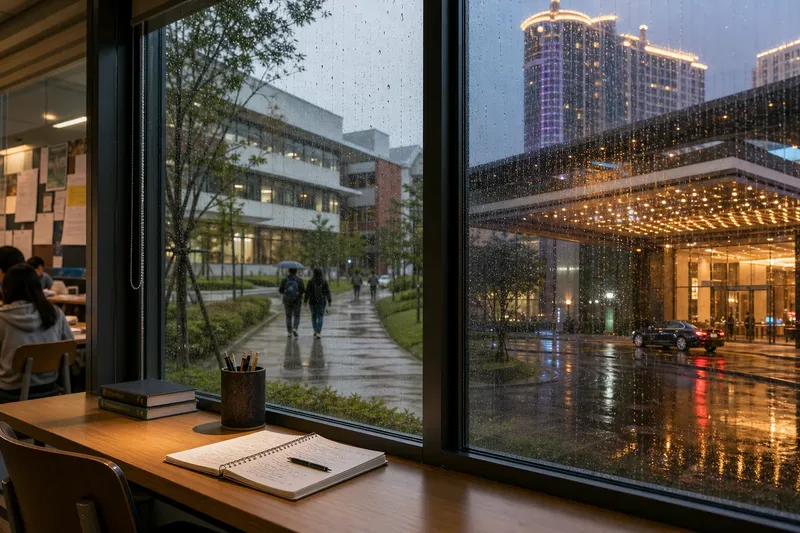
The most common mistake in a rainy-day image of a campus or casino is treating windows as scenery. That can flatten the way glass frames a room, a route, or a visitor’s first view of a place. For a caption about campus and casino windows in rain, start with what the pane actually shows.
Campus window details
In a university image, look for desks, study tables, notebooks, noticeboards, or people working near the glass. Then name the visible outdoor setting: perhaps a path, courtyard, or another building. A view across campus alone does not establish that the room is used for studying.
For an invented scene, imagine a study-area window at Greenwich Việt Nam facing a campus path. If the frame includes a desk, notebook, and people walking outside, a caption can connect those visible details; it cannot establish who uses the room or how the campus operates.
Describe the window’s borders as carefully as its view. A broad pane may leave much of a courtyard visible, while a sill, curtain, or narrow frame may interrupt the scene. Say what the photograph shows rather than assigning a fixed purpose to the design.
Casino entrance framing
A casino destination image may show a covered drop-off, entrance sign, doorway, or illuminated lobby through a pane. These details can make the approach visible without showing what lies beyond a closed door.
Notice the sequence the frame includes: perhaps street, canopy, entrance, and lobby. Reflections may layer several of those areas together. If the image does not make the source of a shape clear, describe the reflection instead of identifying it as a sign, person, or light.
Do not assume every campus window or casino entrance serves the same purpose. Describe the details in the particular image, and avoid claiming how visitors are treated or how access works beyond the frame.
Rain and reflections
Droplets, streaks, glare, and reflected lights can compete with the room and the view outside. Decide which layer draws attention first: the interior, the glass, or the exterior. If none stands out, describe how the layers overlap.
Check whether a bright shape belongs to the room, the view outside, or a reflection on the pane. If its source remains unclear, call it a bright shape or reflection and name what it overlaps. The same approach works for a reflection across a campus path or an entrance area.
Also record what the frame hides. A sill may cut off part of a courtyard, and glare may obscure part of a covered entrance. State what is blocked in the photograph; do not infer that the space is private or inaccessible.
Caption questions
How can I tell if a window shows a study space?
Look for a desk, notebook, chair, or person working, and describe only cues visible in the image. A campus view by itself does not show how the interior is used.
Which details make a casino entrance legible?
A sign, canopy, doorway, or lit lobby may help a reader recognize the entrance area. If rain or reflections obscure those features, describe the visible overlap without claiming the route is clear.
What should I call an unclear reflection?
Use neutral language such as “a pale reflection across the pane,” then say what it overlaps. Name a person, sign, or lamp only when the image makes that identification clear.
Can a photograph show how a place welcomes visitors?
It can show an open view, a covered approach, or a visible entrance. It cannot establish how visitors are treated or what happens outside the frame.
A caption in practice
Say you are captioning an invented photograph from a Greenwich Việt Nam study area. The starting details are one desk, one notebook, two rain-streaked panes, and a walkway visible outside. First, identify the viewpoint as inside a study area; next, describe the notebook beside the wet glass; then name the walkway beyond it. The resulting caption could read: “A notebook rests on a desk inside a Greenwich Việt Nam study area, with rain streaking the glass and a campus walkway beyond.” Because the invented scene includes a desk and notebook, the caption names a study area; if those details were absent, “interior” would be the safer choice.
Caption checks
Use each observation to make a wording decision. If the image does not support the more specific option, choose the alternative.
- Check for a desk, notebook, or study chair. If one is visible, describe a study setting without naming its users; if none is visible, call it an interior.
- Check whether the exterior shows a courtyard, path, or campus building. If it does, name that feature; if rain or cropping hides it, describe the view as obscured.
- Check for a casino canopy, sign, doorway, or lobby. If a feature is clear, use it to describe the entrance area; if reflections conceal it, refer to the entrance area without specifying a route.
- Check which layer is sharpest: room, glass, or exterior. If one dominates, lead with it; if no layer stands out, describe the overlap.
- Check whether a bright shape aligns with interior objects or crosses a reflection. If its source is clear, name it; if not, call it a light or shape.
- Check whether a sill, frame, curtain, or glare blocks the view. If it does, state what part is hidden; if it does not, avoid inventing an obstruction.
Details not worth chasing
Guessing the exact glass type or reconstructing the photographer’s equipment is not worth the effort when the image offers no direct evidence. Those details rarely help explain what the frame actually includes.
For a caption about campus and casino windows in rain, name the visible room, entrance, weather, and reflections, then stop where the evidence stops. That boundary keeps a Greenwich Việt Nam example clearly illustrative and leaves the image—not an invented account of the place—to carry the description.